


AI GOVERNANCE | ROOT CAUSES SERIES
Written by: Devensa AI.
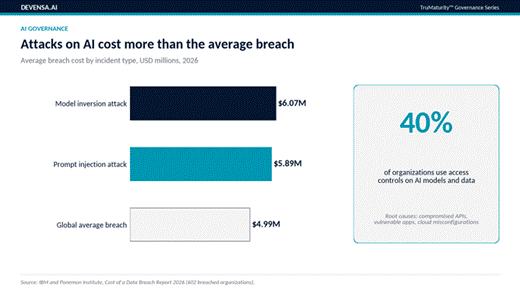
Attacks aimed at AI systems cost more than the average breach: model inversion averaged $6.07 million and prompt injection $5.89 million, against a $4.99 million global average. IBM traced many AI-related breaches to familiar weaknesses such as compromised APIs and cloud misconfigurations, while only 40% of organizations reported access controls on AI models and data.1
AI risk and IT risk overlap, but they answer different questions. IT risk asks whether a system is secure and available. AI risk asks whether a model’s outputs are accurate, fair, explainable, and used within policy. In IBM’s 2026 breach study, roughly one in five organizations reported an AI-related breach, and 92% of those lacked proper AI access controls.1
Where the Line Between AI Risk and IT Risk Falls
IT risk covers the stack: servers, networks, identity, patching, uptime, backup. Those controls still apply to an AI system, because a model runs on infrastructure like any other application.
AI risk starts where the infrastructure questions stop. A model with perfect uptime and locked-down servers still produces biased loan decisions, invents a citation in a customer email, or leaks training data through its answers. None of those failures shows up in a patch report.
NIST makes the distinction explicit. The AI Risk Management Framework includes a full appendix on how AI risks differ from traditional software risks, noting AI systems bring risks current frameworks do not comprehensively address, and testing them is harder because AI is not subject to the same controls as traditional code development.2
The most common misconception: AI governance is a line item in the IT risk register, owned by whoever owns the servers. A second one: AI governance is a tool you buy. Both skip the decisions about acceptable use, model approval, and accountability for outputs.
What the Confusion Costs
Breach cost
IBM’s 2026 Cost of a Data Breach Report put the global average breach at a record $4.99 million. The costliest AI-specific incidents were model inversion attacks at $6.07 million and prompt injection at $5.89 million.1 Model inversion pulls sensitive training data back out of a model through its responses, a failure no firewall rule anticipates.
The root causes IBM found were familiar: compromised APIs, vulnerable applications, cloud misconfigurations.1 IT controls matter. They are necessary, and they are insufficient. IBM itself frames AI security as an operating-model challenge involving architecture, controls, accountability, and oversight.1
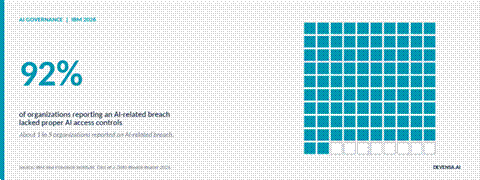
IBM and the Ponemon Institute studied 602 breached organizations for the 2026 Cost of a Data Breach Report. About one in five reported an attack on AI models or applications, and the vast majority of those lacked proper AI access controls. Only 40% of organizations reported using access controls on AI models and data at all.1
Executive accountability
When AI risk sits inside IT, ownership defaults to the technology function. McKinsey’s global AI survey found 28% of respondents whose organizations use AI say the CEO oversees AI governance, and 17% say the board does.3 The same research linked CEO oversight of AI governance to higher reported bottom-line impact from generative AI.3
Boards do not ask whether the AI server is patched. They ask who approved the model, what data trained it, and who answers when an output harms a customer. In the Devensa vC-Suite model, those questions belong to the vCAIO, the AI-powered virtual officer for AI Governance.
Investment after the fact
More than half of breached organizations told IBM they plan to invest in AI security and governance tools after the breach, an 88% increase from the prior year.1 Governance bought after an incident costs more and arrives later than governance designed before deployment.
Mapping AI Risk to the NIST AI RMF and TruMaturity™
The NIST AI RMF organizes AI risk work into four functions: Govern, Map, Measure, and Manage.2 Govern sets policy and accountability. Map establishes context for each AI use. Measure tests and tracks risk. Manage prioritizes and acts. Only one of those four overlaps heavily with traditional IT operations.
Devensa.AI scores AI Governance as its own domain on the TruMaturity™ framework. The AI-mediated assessment produces a Domain Maturity Score for AI Governance on the CMMI scale: 1 Initial, 2 Developing, 3 Defined, 4 Managed, 5 Optimized. The same assessment produces an Overall Effectiveness Score across all six domains.
The tenant sets a target level for the domain. The gap between current and target becomes a prioritized, owner-assigned roadmap. Reassessment, typically annual, shows whether the AI Governance score moved, and why.
The Parts of AI Governance IT Risk Management Does Not Cover
An AI use inventory. A register of every model, embedded AI feature, and third-party AI tool in use, including the ones nobody approved. IT asset lists track hardware and licenses, rarely model purpose or decision scope.
Risk tiering by use case. A chatbot drafting marketing copy and a model scoring job applicants need different review depth. The tier follows the decision, not the technology.
Data provenance. Where the training and grounding data came from, whether consent covers this use, and whether sensitive records sit inside the model’s reach.
Output review and human oversight. Defined points where a person checks AI output before the output reaches a customer, a regulator, or a decision record.
Monitoring after launch. Drift, accuracy decay, and changed vendor terms. A model approved in March behaves differently by October.
Five Moves to Pull AI Risk Out of the IT Queue
- Name an executive owner for AI Governance outside IT operations, with a direct reporting line to the CEO or board.
- Build the AI inventory first. Ask every department head to list AI tools in use, then reconcile the list with procurement and expense data.
- Tier each use case by impact on people, money, and regulated data. Set review depth by tier.
- Add AI-specific access controls: who prompts, who fine-tunes, who connects the model to internal data.
- Report AI risk to the board as a separate line from cybersecurity, with its own score and trend.
Frequently Asked Questions
Is AI risk a subset of IT risk?
No. The two overlap at the infrastructure layer, where AI systems need the same security controls as any application. AI risk also covers output accuracy, bias, explainability, data use, and accountability for decisions, which sit outside traditional IT risk management. NIST treats these as distinct in its AI Risk Management Framework.2
Who should own AI governance in a growing company?
An executive with authority across business units, not only the technology team. AI decisions touch legal, HR, product, and customer operations. In the vC-Suite model, the role is the vCAIO, focused on responsible AI strategy, governance, and AI risk management.
What is shadow AI, and why does IT miss it?
Shadow AI is any AI tool used without approval or oversight. Employees adopt browser-based AI tools without new hardware or a purchase order, so the activity rarely shows up in IT asset tracking. An AI use inventory built with department heads surfaces what system scans miss.
Which framework fits AI governance best?
The NIST AI RMF is a strong, voluntary starting point for most organizations, organized around Govern, Map, Measure, and Manage.2 Organizations with EU exposure or certification goals often add the EU AI Act and ISO/IEC 42001 to the same program.
How does Devensa.AI score AI governance maturity?
The TruMaturity™ assessment scores AI Governance as one of six domains on the CMMI scale, from 1 Initial to 5 Optimized, and rolls all six into an Overall Effectiveness Score. Gaps convert into roadmap tasks, and every AI-generated recommendation passes a human approval gate before anything is published or acted on. Where does AI risk sit in your organization today: in an IT ticket queue, or on the board agenda?
| Give AI Governance Its Own Score Devensa.AI is in early access ahead of launch. The platform unifies six governance domains through AI-powered vOfficer capabilities: vCISO, vCAIO, vCRO, vCCO, vCPO, and vCDO, augmented by Devensa subject-matter experts where needed. Your AI Governance Domain Maturity Score sits on the dashboard next to the other five. When the score moves, you see why. Who in your organization signs off before a new AI tool touches customer data? Schedule an early-access demo: info@devensa.ai Not ready to talk yet? Take the free Governance Readiness Assessment at devensa.ai. |
Sources
1. IBM and Ponemon Institute, Cost of a Data Breach Report 2026, summarized in “AI‑powered adversaries and the enterprise risk challenge,” IBM Think, July 29, 2026. https://www.ibm.com/think/x-force/2026-cost-of-a-data-breach-ai-adversaries-enterprise-risk
2. NIST, AI Risk Management Framework 1.0 (NIST AI 100-1), Appendix B: How AI Risks Differ from Traditional Software Risks, NIST AI Resource Center. https://airc.nist.gov/airmf-resources/airmf/appendices/app-b-how-ai-risks-differ-from-traditional-software-risks
3. McKinsey & Company, “The state of AI: How organizations are rewiring to capture value,” McKinsey Global Survey, March 2025. https://www.mckinsey.com/capabilities/quantumblack/our-insights/the-state-of-ai-how-organizations-are-rewiring-to-capture-value
This article is provided for informational purposes only and does not constitute legal or compliance advice. Consult qualified counsel before making governance decisions.
Responses