


RISK MANAGEMENT | VENDOR & THIRD-PARTY RISK
Written by: Devensa AI
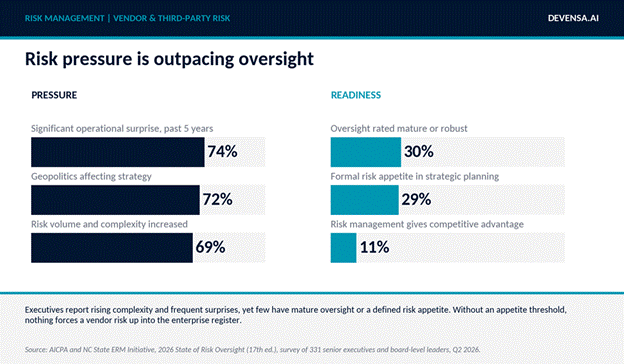
Figure: Pressure indicators run between 69% and 74%, while readiness indicators run between 11% and 30%. Sources: AICPA and NC State ERM Initiative, 2026 State of Risk Oversight.36
Vendor risk usually lives in a third-party risk tool, a security tracker, or procurement files, while the enterprise risk register holds the strategic and operational risks a board reviews. The two rarely connect. In a Gartner survey of executive risk committee members, 84% said third-party risk misses had disrupted operations.1
Assessed Is Not the Same as Managed
Seen from risk management, third-party risk is the possibility that a vendor’s failure affects enterprise objectives: revenue, operations, compliance, or reputation. Many organizations assess vendors in detail at onboarding. The trouble is where those assessments land. They produce vendor-level scores in a separate system, on a separate scale, owned by a separate team, while the register lists “operational disruption” or “cyber incident” with no line of sight to the suppliers that could cause them.
The misconception is that a mature TPRM program means vendor risk is managed. It means vendor risk is assessed. Managed implies the risk is weighed against appetite, owned by someone with authority, and reported alongside every other risk competing for attention and budget.
Five Reasons Vendor Risk Stays Stranded
1. The scales do not translate
A vendor rated “high” on a three-point security scale cannot be compared with an enterprise risk scored on a five-by-five likelihood and impact matrix. Without a crosswalk, vendor ratings never aggregate upward.
2. Risk acceptance happens in the contract
Business owners often proceed with a vendor after being told of the risk. Gartner recommends tracking third-party contract decisions so that risk acceptance by business owners is visible.2 When acceptance lives only in an email thread, the register never learns the risk exists.
3. Concentration is invisible vendor by vendor
Ten moderate vendors that depend on the same cloud region or payment processor can add up to one severe enterprise risk. Scoring each vendor alone does not show it.
4. There is no appetite to measure against
The 2026 State of Risk Oversight study from the AICPA and NC State found that only 29% of organizations have formally articulated risk appetite in the context of strategic planning.3 Without an appetite statement, no threshold forces a vendor risk up to the register.
5. Point-in-time data ages out
Gartner research found that 83% of legal and compliance leaders identified third-party risks after due diligence and before recertification.4 Risks found mid-relationship have no natural route into an annual register refresh.
What the Disconnect Costs
The same 2026 study found that 74% of organizations experienced a significant operational surprise in the past five years, while only 30% rate their risk oversight as mature or robust.3 In Gartner’s survey of third-party cybersecurity risk leaders, 45% of organizations experienced third party-related business interruptions over two years, and only 6% were effective across all three outcomes Gartner measured.2 IBM’s 2026 breach data adds a price: supply chain compromise ranked first among 30 cost factors, adding $227,250 per breach.5
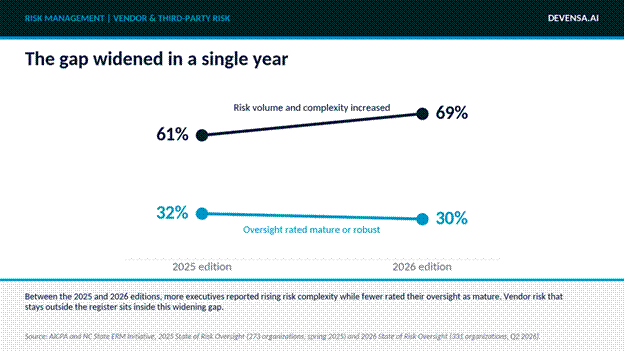
Figure: From the 2025 to the 2026 edition, reported risk complexity rose from 61% to 69% while mature or robust oversight slipped from 32% to 30%. Sources: AICPA and NC State ERM Initiative (2025, 2026).76
Boards experience the gap as surprises. The platform’s vCRO capability, an AI-powered vOfficer augmented by Devensa subject-matter experts where needed, is built to translate vendor-level findings into the enterprise risk language a board already reads.
Three Lines, One Register
The IIA’s Three Lines Model settles ownership. The first line, the business owner of the vendor relationship, owns the risk and the decision to accept it. The second line, risk management, security, and compliance, sets the method, challenges the ratings, and aggregates exposure. The third line, internal audit, tests independently whether vendor risk reaches the register as designed.
COSO’s Enterprise Risk Management framework supplies the connection points. Its Performance component covers identifying, assessing, and prioritizing risk against appetite, and its Information, Communication, and Reporting component requires that risk information reach the people who decide. ISO 31000 reinforces the same principle: risk management is integrated, not parallel.
Devensa AI scores this through TruMaturity™, the methodology and six governance domains shared across Devensa. On the platform, the TruMaturity™ Assessment is designed as an AI-mediated, adaptive assessment, triggered on first sign-in and roughly annually after that, with scores mapped to the five CMMI maturity levels. For vendor risk integration, the levels read like this:
- Level 1, Initial: Vendor risk is handled case by case, with no link to enterprise risk.
- Level 2, Managed: A TPRM process rates vendors, but results stay in a separate system.
- Level 3, Defined: Vendor ratings translate to the enterprise scale, and material vendors map to register entries.
- Level 4, Quantitatively Managed: Concentration, appetite thresholds, and risk acceptances are measured and reported.
- Level 5, Optimizing: Register trends shape vendor strategy, tiering, and exit planning.
Building the Bridge
- Publish a crosswalk. Define how each vendor rating translates to enterprise likelihood and impact.
- Link vendors to existing risks. Tag each critical vendor to the register entries it could trigger, instead of adding a single “vendor risk” line.
- Log every risk acceptance. Record who accepted residual vendor risk, when, and under which appetite threshold.
- Run a concentration view. Group vendors by shared dependencies such as hosting provider, region, or sole-source status.
- Report vendor exposure in the same pack. Present it to the risk committee next to the risks it affects, not in an appendix.
Frequently Asked Questions
Should vendor risk be one line in the enterprise risk register?
Usually not. A single “third-party risk” line hides which objectives are exposed. Linking material vendors to the specific enterprise risks they could trigger is more useful, with a separate concentration entry where dependencies cluster.
Who owns vendor risk under the Three Lines Model?
The first line, meaning the business owner of the relationship, owns the risk. The second line provides methods, oversight, and challenge. Internal audit, as the third line, provides independent assurance.
What is third-party concentration risk?
It is the exposure created when multiple vendors or critical processes depend on the same provider, location, or technology. It often becomes visible only when vendor data is aggregated.
How does risk appetite apply to vendors?
An appetite statement sets thresholds, for example, no sole-source dependency for a revenue-critical process without a tested exit plan. Vendor ratings above a threshold then require escalation and a recorded decision.
How often should vendor risk feed the register?
Critical vendors should update the register whenever their rating changes materially, with a full reconciliation at each register review. If your board asked tomorrow which enterprise risks depend on a single vendor, how long would the answer take?
| Put Vendor Risk Where the Board Can See It Devensa AI is a multi-tenant governance platform preparing for launch. Its vCRO capability, an AI-powered vOfficer augmented by Devensa subject-matter experts where needed, is designed to translate vendor findings into enterprise risk terms and score the results within TruMaturity™. Schedule a demo to see how it is structured. For a self-serve start, the free Governance Readiness Assessment is planned for devensa.ai. Which of the risks on your register today could be triggered by a vendor you have not linked to it? Schedule a demo: info@devensa.ai | Early access and the Governance Readiness Assessment: devensa.ai |
Sources
1. Corporate Compliance Insights, “Gartner: 84% of Enterprise Risk Management Teams Have Overlooked a Third-Party Issue,” reporting Gartner’s September 2022 survey of 100 executive risk committee members (March 2023). https://www.corporatecomplianceinsights.com/gartner-erm-miss/
2. Gartner, “Gartner Survey Finds 45% of Organizations Experienced Third Party-Related Business Interruptions During the Past Two Years” (December 13, 2023). https://www.gartner.com/en/newsroom/press-releases/2023-12-13-gartner-survey-finds-45-percent-of-organizations-experienced-third-party-related-business-interruptions-during-the-past-two-years
3. NC State University Poole College of Management, “Report: Strategic Integration of Risk Management Remains Limited,” on the AICPA and NC State ERM Initiative 2026 State of Risk Oversight (September 2026). https://poole.ncsu.edu/thought-leadership/article/report-strategic-integration-of-risk-management-remains-limited/
4. Gartner, “Gartner Says More Than Eight in 10 Organizations Discover Third-Party Risks After Due Diligence Period” (August 15, 2019). https://www.gartner.com/en/newsroom/press-releases/2019-08-15-gartner-says-more-than-eight-in-10-organizations-disc
5. IBM and Ponemon Institute, Cost of a Data Breach Report 2026, supply chain cost-factor findings as analyzed by Cycode (August 6, 2026). https://cycode.com/blog/ibm-cost-of-data-breach-2026/
6. AICPA & CIMA, “Rising Risk Complexity Outpaces Organizations’ Strategic Readiness Finds New AICPA & North Carolina State University Study” (September 9, 2026). https://www.aicpa-cima.com/news/article/rising-risk-complexity-outpaces-organizations-strategic-readiness-finds-new-aicpa-and-north-carolina-state-university-study
7. AICPA and NC State ERM Initiative, 2025 State of Risk Oversight news release via PR Newswire (September 8, 2025). https://www.prnewswire.com/news-releases/us-organizations-overlook-risk-management-as-a-strategic-priority-despite-ongoing-uncertainty-and-growing-global-risks-302549170.html
This article is provided for informational purposes only and does not constitute legal or compliance advice. Consult qualified counsel before making governance decisions.
Responses