


PRIVACY | VENDOR & THIRD-PARTY RISK
What privacy law expects once personal data leaves your hands
Written by: Devensa AI
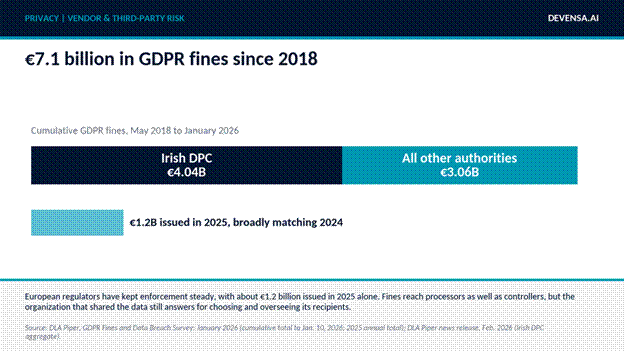
Figure: Cumulative GDPR fines reached €7.1 billion by January 2026, €4.04 billion of it from the Irish DPC, with about €1.2 billion issued in 2025. Sources: DLA Piper (January and February 2026).15
Third-party data sharing is any disclosure of personal data to an outside party, whether a processor acting on your instructions or an independent recipient using the data for its own purposes. Your accountability does not transfer with the data. European regulators issued about €1.2 billion in GDPR fines in 2025 alone.1
Sharing Is a Spectrum, Not a Single Act
Privacy law sorts recipients by what they may do. Under the GDPR, a processor handles data only on the controller’s documented instructions under an Article 28 contract; an independent controller sets its own purposes and carries its own obligations; joint controllers share purposes and must allocate responsibilities. U.S. state laws draw a similar line between service providers and third parties, and California treats disclosure for cross-context behavioral advertising as sharing, which triggers opt-out rights.
The common misconception is that a signed data processing agreement settles the question. A DPA is necessary, but it describes permitted use. It does not show what the recipient does, which sub-processors it adds, or whether data is deleted when the relationship ends.
Why Regulators Keep Looking Downstream
Enforcement is sustained
DLA Piper’s January 2026 survey puts cumulative GDPR fines since May 2018 at €7.1 billion.1 The €1.2 billion fine imposed on Meta in 2023 over EU-to-U.S. transfers remains the reference point for what a transfer failure can cost.1
Processors are directly liable
The same survey notes that processors, as well as controllers, are directly liable for breaches of the security principle, and several fines were imposed directly on processors.2 That sharpens vendor incentives. It does not remove the sharing organization’s own accountability for choosing and overseeing the processor.
Breaches increasingly start outside
Personal data breach notifications in Europe rose 22% to an average of 443 per day.1 Verizon’s 2026 DBIR found a third party involved in 48% of breaches.3 When a recipient is breached, the notification clock and the regulator’s questions usually land on the organization that shared the data.
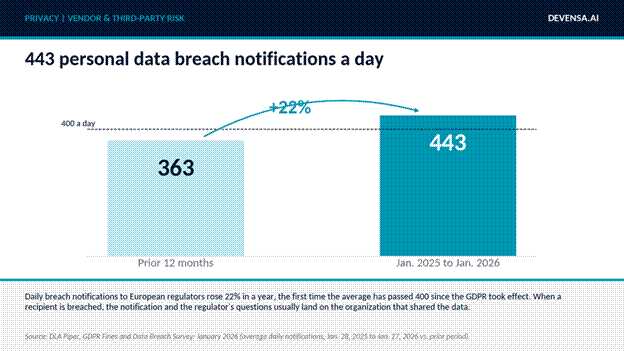
Figure: Average daily personal data breach notifications in Europe rose from 363 to 443, up 22% and above 400 for the first time since the GDPR took effect. Source: DLA Piper (January 2026).1
Trust depends on explaining the flow
In Cisco’s 2026 Data and Privacy Benchmark Study, 46% of respondents pointed to clear communication about how data is collected and used as the step that builds customer confidence.4 A flow that has not been mapped cannot be explained. The platform’s vCPO capability, an AI-powered vOfficer augmented by Devensa subject-matter experts where needed, is designed to tie each flow and its legal basis to a governance record rather than to a stack of contracts.
The Fair Information Practice Principles, Applied to Every Recipient
The Fair Information Practice Principles, codified in the OECD Privacy Guidelines, predate modern privacy statutes and still describe what regulators check. Four of the eight carry particular weight in third-party sharing:
- Purpose specification and use limitation: a recipient uses data only for the documented purpose it was shared for.
- Collection limitation: share the minimum fields needed, not the full record because it is convenient.
- Security safeguards: protection obligations travel with the data, through contract and verification.
- Accountability: the organization that shared the data remains answerable for how it is handled.
Privacy by Design adds the operating rule: build those limits into the integration itself, so a vendor receives a minimized feed by default instead of relying on the vendor’s restraint.
Devensa AI scores this through TruMaturity™, the methodology and six governance domains shared across Devensa. On the platform, the TruMaturity™ Assessment is designed as an AI-mediated, adaptive assessment, triggered on first sign-in and roughly annually after that, with scores mapped to the five CMMI maturity levels. For third-party data sharing, the levels read like this:
- Level 1, Initial: Data leaves through integrations and exports that no one has catalogued.
- Level 2, Managed: DPAs exist for known processors and are stored with procurement.
- Level 3, Defined: A sharing inventory records recipient role, purpose, legal basis, and transfer mechanism.
- Level 4, Quantitatively Managed: Sub-processor changes, deletion confirmations, and rights requests are tracked against service levels.
- Level 5, Optimizing: Sharing decisions are revisited as purposes change, and unneeded flows are shut off.
The Working Parts of a Defensible Sharing Program
A map of every outbound flow
List each recipient, the data categories it receives, the purpose, and the sending system. Marketing pixels, analytics SDKs, and support tools are frequent omissions.
Role classification
Label each recipient as processor, independent controller, joint controller, service provider, or third party. The label determines which contract terms and notices apply.
Sub-processor visibility
Require advance notice of new sub-processors and a right to object. The real custody chain is often longer than the contract suggests.
Cross-border transfer mechanisms
For data leaving the EU or UK, record the transfer tool relied on (an adequacy decision, the EU-U.S. Data Privacy Framework, or standard contractual clauses) and the transfer impact assessment behind it.
Rights and deletion pass-through
Access, deletion, and opt-out requests must reach recipients. Confirm how each vendor receives them and how it proves completion.
Four Steps to Take This Quarter
- Rebuild the recipient list from systems, not contracts. Tag managers, API logs, and SSO app lists surface recipients procurement never saw.
- Classify roles and fix mismatches. A vendor labeled a processor but using data for its own product development is a finding, not a footnote.
- Minimize the feeds. Remove fields recipients do not need before renegotiating anything else.
- Test deletion. Ask two vendors to confirm deletion of a sample record, and time the response.
Frequently Asked Questions
What counts as third-party data sharing under privacy law?
Any disclosure of personal data to an entity outside the organization, including processors and service providers acting on instructions, and independent recipients using data for their own purposes. The recipient’s role determines which obligations apply.
Is a data processing agreement enough?
It is required for processors under GDPR Article 28, but it is not sufficient on its own. Regulators also look at whether the controller chose the processor carefully, gave documented instructions, and verified compliance over time.
What is the difference between a processor and a third party?
A processor handles data only on your instructions and for your purposes. A third party, or independent controller, decides its own purposes. Selling or sharing data with a third party typically triggers additional notice, consent, or opt-out obligations.
How do sub-processors affect our obligations?
A processor engaging a sub-processor must flow down equivalent obligations, and under the GDPR it needs the controller’s prior authorization. The controller should know who those sub-processors are and where they operate.
How often should data-sharing arrangements be reviewed?
Review when purposes, data categories, or sub-processors change, and at least annually for recipients of sensitive data. How many of your current recipients would still receive the same fields if you designed each flow today?
| Know Where Your Personal Data Goes Devensa AI is a multi-tenant governance platform preparing for launch. Its vCPO capability, an AI-powered vOfficer augmented by Devensa subject-matter experts where needed, is designed to keep each outbound data flow tied to its recipient role, purpose, and legal basis and score the results within TruMaturity™. Schedule a demo to see how it is structured. For a self-serve start, the free Governance Readiness Assessment is planned for devensa.ai. Could you list every organization that received your customers’ personal data last month? Schedule a demo: info@devensa.ai | Early access and the Governance Readiness Assessment: devensa.ai |
Sources
1. DLA Piper, GDPR Fines and Data Breach Survey: January 2026. https://www.dlapiper.com/en-us/insights/publications/2026/01/dla-piper-gdpr-fines-and-data-breach-survey-january-2026
2. DLA Piper, “GDPR Fines and Data Breach Survey: January 2026,” via Lexology (January 21, 2026). https://www.lexology.com/library/detail.aspx?g=342e071b-2a10-44b1-b7ae-f19b73cac7fe
3. Verizon, “Breach entry point, 2026 DBIR finds” (2026 Data Breach Investigations Report news release, May 19, 2026). https://www.verizon.com/about/news/breach-industry-wide-dbir-finds
4. Cisco, 2026 Data and Privacy Benchmark Study (2026). https://www.cisco.com/c/en/us/about/trust-center/data-privacy-benchmark-study.html
5. DLA Piper, “Personal data breaches in Europe reach 443 per day in dramatic 22% jump, DLA Piper analysis reveals” (February 2026). https://www.dlapiper.com/en/news/2026/02/personal-data-breaches-in-europe-reach-443-per-day-in-dramatic-22-jump-dla-piper-analysis-reveals
This article is provided for informational purposes only and does not constitute legal or compliance advice. Consult qualified counsel before making governance decisions.
Responses