


PRIVACY
Written by: Devensa Advisory
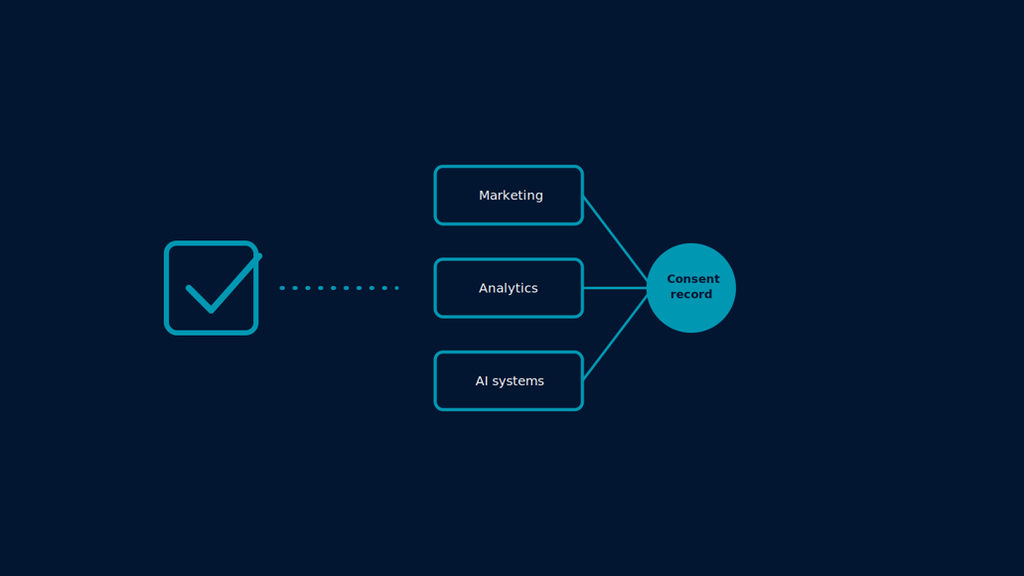
A checked consent box is not the same as a lawful, informed, and revocable consent record that holds up across every downstream system. Source: DLA Piper, GDPR Fines and Data Breach Survey: January 2026
Consent, under privacy law, means a freely given, specific, informed, and unambiguous indication that a person agrees to how their data is used. A pre-checked box or a cookie banner with only an Accept button meets almost none of those conditions. European regulators have kept enforcing that distinction at scale: DLA Piper’s January 2026 GDPR Fines and Data Breach Survey found supervisory authorities issued approximately €1.2 billion in fines in 2025 alone1, bringing the cumulative total since 2018 to roughly €7.1 billion.
What a Checkbox Actually Proves
A checkbox proves someone clicked. It does not prove the person understood what they agreed to, that the choice was genuinely optional, or that withdrawing consent is as easy as giving it. Privacy governance built around a single consent mechanism collapses a real compliance obligation into a single moment, treating consent as a one-time event captured at sign-up rather than an ongoing relationship that has to hold up if a regulator or a customer ever asks how a specific piece of data ended up being used a specific way.
Privacy is frequently mistaken for a single department’s compliance task, satisfied once legal signs off on a cookie banner and a privacy policy. That framing misses where the actual exposure lives: in the systems downstream of consent, where data collected under one stated purpose gets reused for another, and where nobody can trace whether the original consent still covers the new use.
The Enforcement Record Is Not Slowing Down
The DLA Piper survey’s most significant single enforcement action in 2025 was a €530 million fine against a social media company for violations tied to international data transfer restrictions and transparency failings2, underscoring that transparency about how consent is obtained and what it actually authorizes remains a central regulatory focus, not a settled issue. Ireland’s Data Protection Commission alone has now issued more than €4 billion in aggregate fines since GDPR took effect.
Customers are watching the same gap. Cisco’s 2026 Data and Privacy Benchmark Study found that transparency ranks as the single most powerful driver of customer trust, cited by 44 percent of respondents, ahead of strong security guarantees at 43 percent and the ability to limit data sharing at 41 percent3. A consent mechanism that technically satisfies a regulator but leaves a customer unclear on what they agreed to is failing the trust test even where it passes the legal one.
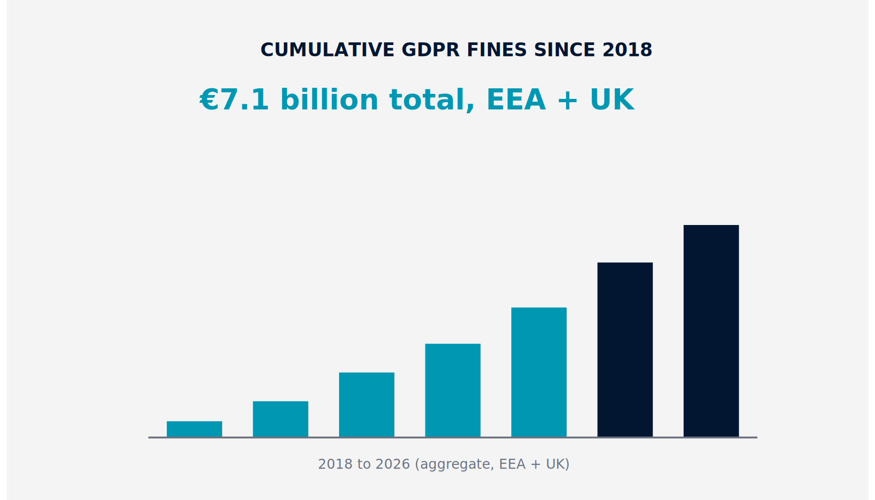
European supervisory authorities have issued roughly €7.1 billion in cumulative GDPR fines since 2018, including about €1.2 billion in 2025 alone.Source: DLA Piper, GDPR Fines and Data Breach Survey: January 2026
Consent as a System, Not a Screen
A privacy program built on a genuine consent architecture treats consent as something that has to be tracked, honored, and revocable across every system that touches the data it authorized, not just captured once at the front door. That means the marketing platform, the analytics pipeline, and any AI system trained on customer data all have to respect the same consent record, and a withdrawal has to actually propagate through all of them, not just remove a person from one mailing list.
A vCPO owns that architecture. As a fractional executive delivered on an hours-pooled retainer, the vCPO designs the consent framework that holds up past the initial checkbox, builds the process for propagating a withdrawal across every downstream system, and represents the organization’s privacy posture to regulators and customers alike with more authority than a policy document can carry on its own.
Grounding Consent in Recognized Frameworks
Fair Information Practice Principles
The FIPPs, the foundational set of principles behind most modern privacy law, include use limitation and purpose specification: data collected for one stated purpose should not be quietly repurposed for another without new consent. A checkbox obtained at sign-up for one purpose does not travel automatically to a new use case introduced eighteen months later, no matter how the original consent language was worded.
Privacy by Design
Privacy by Design treats privacy as a default built into a system’s architecture, not a control bolted on after the system is built. Applied to consent specifically, this means the systems that use customer data are built from the start to check the current, active consent record before acting, rather than relying on a compliance team to manually audit for violations after the fact.
The TruMaturity™ Assessment scores Privacy as one of six governance domains against the CMMI maturity scale, from Initial through Optimized. A program anchored entirely on a cookie banner and a static privacy policy, with no mechanism for tracking consent across downstream systems, typically scores toward the lower end of that scale, because the assessment tests whether consent functions as a system, not whether the initial capture mechanism exists.
What a Real Consent Framework Includes
- A consent record tied to specific, itemized purposes, not a single blanket acceptance.
- A mechanism for propagating a withdrawal across every downstream system that touches the data.
- Clear separation between what is required for the service to function and what is optional.
- A defined process for handling new use cases that fall outside the original stated purpose.
- Documentation an organization can actually produce if a regulator asks how a specific consent was obtained and what it covered.
Where to Start Closing the Gap
- Inventory every system that currently relies on a consent record, not just the one that captures it.
- Separate purposes in the consent mechanism itself, rather than bundling everything into a single accept action.
- Build the withdrawal path before you need it. Test whether revoking consent in one place actually removes the data’s use everywhere it has been shared internally.
- Review any new use case against the original consent language before deployment, not after a complaint surfaces the mismatch.
- Bring privacy reporting to the board in terms of consent integrity, not just cookie-banner acceptance rates.
Frequently Asked Questions
Is a cookie banner enough to satisfy GDPR consent requirements?
On its own, no. GDPR requires consent to be freely given, specific, informed, and unambiguous, and a banner offering only an Accept option, with no equally easy way to decline or manage specific purposes, does not meet that standard. Regulators have continued to fine organizations over exactly this pattern.
What is the difference between consent and legitimate interest as a legal basis for processing data?
Consent requires an affirmative, informed opt-in from the individual. Legitimate interest allows processing without consent when the organization’s interest is balanced against the individual’s rights, documented through a formal assessment. Organizations sometimes misuse legitimate interest to avoid seeking consent they would otherwise need, which is itself a common enforcement target.
How does an AI system complicate consent management?
An AI system trained on customer data can extend a data’s use well beyond the purpose the original consent covered, and once data is embedded in a trained model, withdrawing consent becomes technically harder to fully honor. This is a growing area of regulatory attention and a reason consent architecture has to be built before AI systems are connected to customer data, not after.
Does a small or mid-market organization need a formal consent management platform?
Not necessarily a dedicated platform, but it does need a documented process for tracking what was consented to, propagating withdrawals, and reviewing new use cases against original purposes. The size of the tool matters less than whether the process actually exists and is followed.
What happens when a customer withdraws consent but the data has already been shared with a third party?
A genuine consent framework requires notifying downstream recipients of the withdrawal and confirming they stop processing the data as well, which is why third-party data-sharing agreements need withdrawal clauses built in from the start. Could your organization currently trace where a single customer’s data has gone since they first said yes?
| Find Out If Your Consent Framework Would Hold Up A checked box at sign-up is the easiest part of consent to get right. What regulators and customers are actually testing is what happens after. The TruMaturity™ Snapshot gives you a fast, structured read on Privacy maturity in about ten minutes. If a customer asked you to trace and withdraw their consent today, could your systems actually do it? Take the 10-Minute TruMaturity™ Snapshot: https://trumaturity.devensaadvisory.com Schedule a Consultation: mailto:info@devensaadvisory.com |
Sources
1. DLA Piper, GDPR Fines and Data Breach Survey: January 2026 — https://www.dlapiper.com/en-sa/insights/publications/2026/01/dla-piper-gdpr-fines-and-data-breach-survey-january-2026
2. DLA Piper, GDPR Fines and Data Breach Survey 2026, full report — https://blogs.dlapiper.com/advocatus/files/2026/01/dla-piper-gdpr-fines-and-data-breach-survey-2026.pdf
3. Cisco, 2026 Data and Privacy Benchmark Study, cited via MIT-adjacent analysis on privacy-led UX — https://ppc.land/mit-report-why-privacy-led-ux-is-now-a-marketing-imperative-in-the-ai-age/
This article is provided for informational purposes only and does not constitute legal or compliance advice. Consult qualified counsel before making governance decisions.
Responses